Friday, November 4, 2011

Emoticons Enhance Expression :)

Some critics of text messaging feel it is ineffective communication because it is void of emotion, lacking the message enhancements that tone of voice and nonverbal expression provide. Maybe those critics never received a love note. Yes, text messages are short, quick, and full of abbreviations. However, the back and forth nature of texting more closely resembles conversation than a note or letter. As we have seen, it is a combination of two forms of communication which has proven very appealing to teens and tweens. In addition to needing to find the right word to convey emotions A whole new means of communicating feelings and emotions has developed for use with texting called emoticons. Emoticons are symbols used to represent feelings. The use of emoticons in text messages makes them very effective in expressing the feelings that go with the words. In The Seattle Times David Silver, a University of Washington professor of communication who studies new media is quoted, “The beauty of language is that it’s infinitely morphable. The use of emoticons is amazing as a way of transmitting spoken language’s social nuances” (Dunnewind, 2003)

Of course, the nonverbals, which communicate much of the emotional content of a message, are not available in a text message. They have not been in e-mail, written letters, telegraph, or smoke signals either. Perhaps this condition encourages more expressive writing, better communication than a phone call or a face to face conversation, which can at times be too full of emotion. Rather than trying to read nonverbals, gain insight through tone of voice, or decipher feelings, in a text message we can use or see the feeling associated with the message through the use of an emoticon. There are websites that offer a glossary for emoticons. For example, at http://www.sharpened.net/glossary/emoticons.php you can type in the emotion and search for the emoticon. This, however, can be a little time consuming, yet fun. There are shortcuts for emoticons for all of the major instant messaging and email sites, and most are also usable with cell phones. Many cell phones now come equipped with symbolic expressions such as various smileys. You may want to search around on your phone or ask your students to show you what is on their phones. You will find that any feeling necessary can be expressed in a text message, possibly more clearly than simple body cues, facial expressions, or tone of voice.

Text Talk: Classroom Stories
I've learned to pay attention to emoticons in students' messages. I had texted a girl I was concerned about when she was absent for four days in a row. She texted back: "fine :(" So I asked her why fine with the frown. She said she hadn't wanted to bother me, but she had found out she had cancer. Many times the emoticon offers enlightening information that can be addressed to fully support students.

EmoticonEmotion EmoticonEmotion EmoticonEmotion
X-( Angry
:-> Grin
)-: Left-handed Sad Face
Broken Heart
=) or :-) Happy
(-: Left-handed Smiley Face
O.o or :-S Confused
<3 Heart or Love
=/ Mad
B-) Cool
{ } Hug
^_^ Overjoyed
:_( or :'( Crying
:-| Indifferent
:-/ Perplexed
*-* Dazed
X-p Joking
=( or :-( Sad
:-( or :( Frown
=D Laughing Out Loud
:-P Sticking tongue out

Tuesday, November 1, 2011

NY Times School Book

We wrote for the NY Times! Join the conversation by leaving a comment.

Click Here to read the article, "Cellphones: Why Not Use Them to Teach?" by Lisa Nielsen and Willyn Webb

Sunday, October 30, 2011

Ideas for Bringing Your Own Device (BYOD) Even If You Are Poor

Listen to this article. Powered by Odiogo.com
When the topic of bring your own device comes up, one of the first complaints we often hear, is "What about the have nots." Yes, there are have nots.  However, students should not only be given the freedom to do what those who have the least can do. Students are not prisoners and they are not widgets. They are people with minds, choices, and parents or guardians who can make decisions and should be empowered to use the learning devices they choose. 


While I believe schools should be wired places where community members can access the internet, I do not believe all students need the same tool nor do I believe all students need the government to provide them with the learning tools they deem best.  When we shift our thinking fromdemanding the government provides one-size-fits-some solutions and move it to let's empower families to take ownership of securing tools for their learning, change can happen.  


Here are some ways even low socio economic status (ses) students can acquire their own technology.

  1. Business Refresh - Reach out to companies to see when they refresh equipment. Ask if they would consider giving old devices to students.
  2. Craigslist - Students can use tools like Craigslist to announce that they are in need of a device that someone might be throwing away. Also, look at who is getting rid of devices. Some will give away technology if it is helping a student.
  3. Facebook for Tech - A teenager I know needed a computer. She put her request on Facebook for anyone who might have an old computer. She had several responses. Students, parents, and teachers can use social media to share requests.
  4. Mentors as resources - Establish a mentoring program. When I did this students developed relationships with their mentors, many of whom advocated on their behalf which included helping them secure resources for learning.
  5. Entrepreneurs raise money for tech - The cost of tech has gone down tremendously. It doesn't take a lot for the entrepreneurial student to raise enough money for his or her own tech.  
  6. Tweet for Tech - When I noticed a young girl with autism in a rural neighborhood could benefit from an iPad I tweeted out a request for anyone updating their iPad 1 with an iPad 2 to donate a device. The young girl had a new iPad that week.  
  7. Recycle School Tech - I've seen schools dump tons of tech because they couldn't deal with the bureaucratic red tape required to give devices to kids.  Ummm...gimme a break! Figure it out.
  8. Payment / Layaway plans - There are schools that have figured out lay away, leasing, or school discount programs. Schools should be doing their best to provide these options for families.
  9. Community Tech Day - Invite the community to come to your school and donate technology for children in need. 
  10. Hold a fundraiser - There are fundraisers for all sorts of things.  Let kids work to raise funds for technology.  Be creative. Hold a race, a car wash, a tournament.  
Yes, there are naysayers who can shoot down every single way I've shared to empower students to secure devices, but when we stop thinking about why we can't and start thinking about how we can, the digital divide narrows before our eyes.

Friday, October 28, 2011

Coaching to Win with Cell Phone Video

    A proven coaching method is the use of film, video, and now cell 

phones. It is often too time consuming and equipment burdensome 

to video and watch practices and games of the whole team, much 

less individual athletes. With cell phones, individual video can be 

taken advantage of during practices. Just put your athletes in groups 

of two or more with at least one cell phone with video capabilities.

 Have the athletes video each other doing key skills. For example, 

serving a volleyball, starts in track, free throws in basketball. The 

replay can be watched immediately in the moment and 

improvement witnessed, corrections to make obvious, and practice 

time fully utilized. It is like putting a coach into every group’s 

hands.


Text Talk: Stories from the Gym
The 6th grade girls practiced their free throws through video in groups of two at the beginning of each practice. The cell phones were put away during the first water break. The remainder of the practice was in large groups. We had our best free throw percentage since I’ve been coaching, which is 13 years.


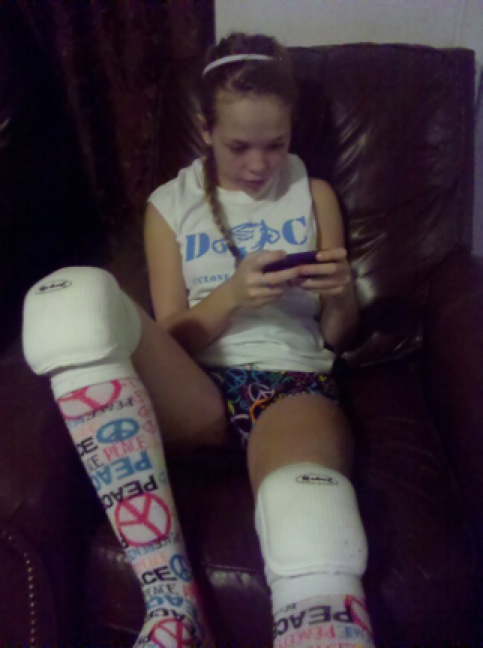
Below, a motivated volleyball player reviews her serve, which she had a friend video on her cell phone so she could look at it later.

Why We Do What We Do...

Teens and Tweens LOVE their phones! That is the reason we opened our minds to joining with them for better communication, strong relationships, and then....ENHANCED LEARNING! This picture features one of my students at Delta Opportunity School who happened to wear this shirt last school year. The shirt says, "Texting is my favorite subject." Joining with students, letting them lead the way, and working together to make school everything it can be is the way to not only prepare them for the world, but have fun along the way! Thanks to all of the students who have texted me, taught me, and motivated me to advocate for using the device they know and love to support their educational endeavors! U R the BST :) <3

Thursday, October 27, 2011

Listen Here!  
Teaching Generation Text on The Brian Lehrer Show!
Listen to this article. Powered by Odiogo.comWillyn Webb and Lisa Nielsen were featured today on the 
Brian Lehrer show on 93.9 FM and and 820 AM. The Brian Lehrer show features interviews with local, national, and international newsmakers, authors, and politicians combined with listener phone calls. 

On the show we discussed the benefits of empowering students with the freedom to learn with the digital tools they own and love and  addressed the importance of going from banning to embracing the power of student-owned technology. Listen to the show below to hear why we think it is important to help students break free from being prisoners of past in a school system designed to prepare students for success in the industrial age.  


We hope after you listen, you will leave a comment here. 

Listen to The Brian Lehrer Show Today! Featuring the authors of "Teaching Generation Text"


Listen to this article. Powered by Odiogo.com
Tune in to listen to Lisa Nielsen, The Innovative Educator, and my Teaching Generation Text co-author Willyn Webb today around 10:20 EST on the Brian Lehrer show on 93.9 FM and and 820 AM. The Brian Lehrer show features interviews with local, national, and international newsmakers, authors, and politicians combined with listener phone calls.  Listen for your opportunity to call in. We'd love to hear other innovative educators on the show!!! You can also join in and leave a comment here. 

We plan to discuss the importance of empowering students with the freedom to learn with the digital tools they own and love. We also hope to address the importance of going from banning to embracing the power of student-owned technology and why this is important if we are to help students break free from being prisoners of past in a school system designed to prepare students for success in the industrial age.