Monday, August 5, 2013

Win a copy of Teaching Generation Text!


Jossey-Bass K-12 Education is celebrating Connected Educator Month with Facebook Giveaways!
There are many great books to be won including Teaching Generation Text.  Spread the news.

 Check out their post with the details here.


Friday, March 8, 2013

TodaysMeet Make Class Neat!

Mrs. Yeager's first hour biology class had a great discussion today that will continue once the bell rings.  They read an article on endangered species and then discussed whether they should be protected or not using a great site called TodaysMeet.  Check out the video here. Check out TodaysMeet here.

Sunday, January 20, 2013

Connecting With Parents Using Celly

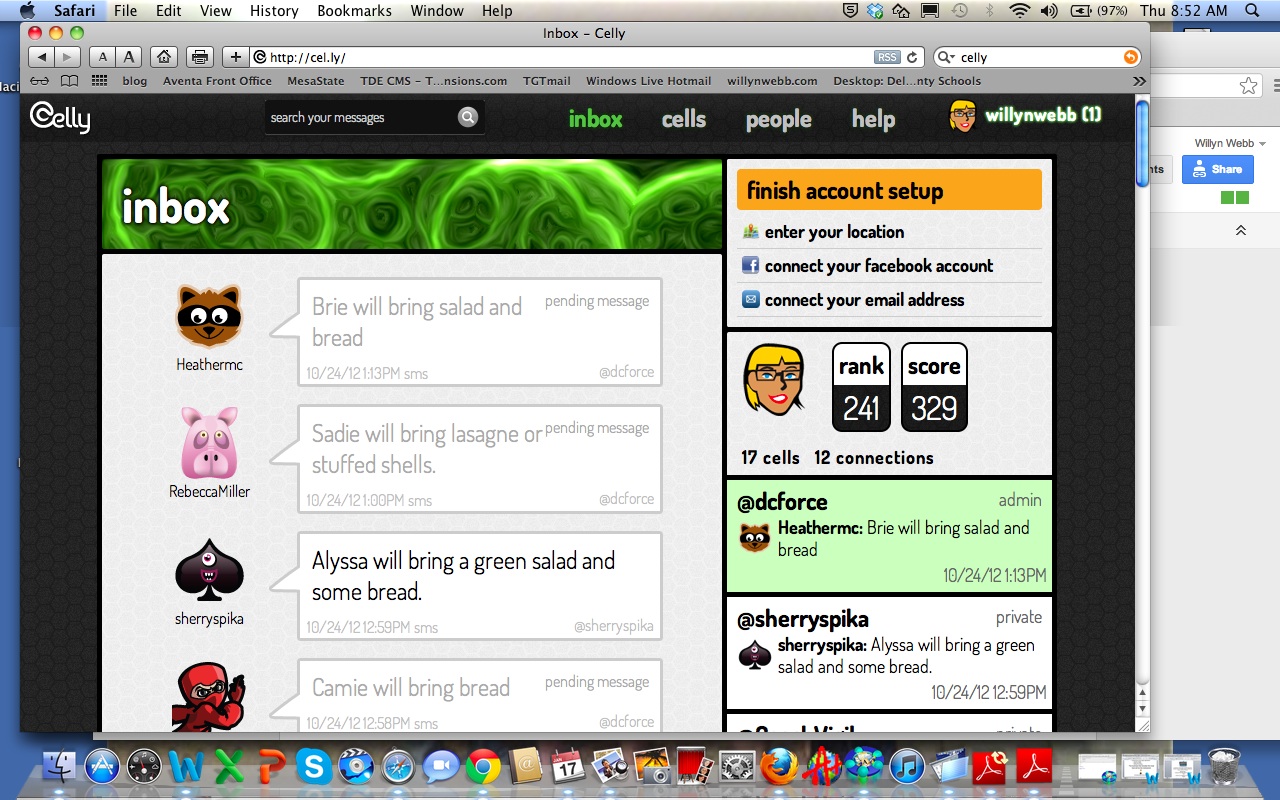
Celly is a free mobile social network through group texting.  It is instant, private, and secure.  There is never an exchange of personal cell phone numbers, yet everyone is connected in the ways that work best depending on the need.   A cell is a mobile social network that works with any mobile phone or device. Members can join instantly with one text and exchange group messages, polls, reminders, and web alerts.  There is a record of all texts sent and received.  

Celly has made a positive improvement for my Parent Accountability Committee (PAC), as they are called in my district.  The PAC meets once per month.  Before Celly I found it frustrating to really provide a picture of what was happening in our school during a once a month meeting.  My solution was to invite them all to join my PAC Cell.  At a meeting I just shared the Celly number and Cell name.  It is so easy to join.  They got out their phones and in the first five minutes of the meeting it was in place.  At first they just responded with logistically input.  For example, it was really easy to set up a last minute Christmas potluck for our December meeting.   Now I send them a quick text almost every day.  I share progress regarding service learning projects, academic milestones, praises for students and staff, struggles, and needs for improvement.  They are welcome, and I sometimes ask them,  to respond and, if applicable, I resend the response text to the group.   We are all communicating often.  During the few seconds it takes me to send a single text they truly become part of the day to day happenings at DOS.  They have shared that this helps them do their job better, look more forward to meetings, and be able to truly advocate for our school.  I feel good about keeping my PAC up to date and informed with the praises, growth, and challenges of DOS.  Next year I plan to invite all parents to be part of a Cell.  I’m already in the habit of sending my PAC a “take-away” from each day.


For more on Teaching Generation Text, check out our book!  
Available through Amazon, Jossey-Bass, Wiley, Barnes 7 Nobel or for a signed copy just email willyn@willynwebb.com

www.teachinggenerationtext.com

Saturday, January 5, 2013

Finally! We Have Proof that Students Use Cell Phones for LEARNING

      A new study is providing a reliable body of research which supports our premise that students use cell phones to learn, and also that schools are not acknowledging or supporting them fully, yet.  We remain hopeful and ask all of you innovative educators and true teachers of generation text to help us share this evidence in hopes of encouraging more schools to stop banning and start embracing student use of mobile devices at school.
      As we have been saying for a few years now, let the students lead.  We need to support students when they choose to use the devices they know, love, and prefer for learning.  Isn't it amazing that as we interact with a growing body of educators who embrace mobile devices for learning, education as a whole is still lagging behind.  Students whether allowed to use their devices in school or not, are moving forward and using them for homework.  You go kids!  
     We, the authors of Teaching Generation Text, are thrilled with the new, reliable research conducted by TRU (see below for methodology and TRU facts).  It was a great day when Layla Rafael sent us this exciting email, 

"Kids FINALLY have a case for why they really need mobile devices - smartphones, tablets, laptops - says the findings of a new, groundbreaking study conducted with middle school students by the Verizon Foundation. The survey is the first of its kind examining how this young age group is using mobile devices to do schoolwork, and reveals that these tools are actually helping kids learn math and science better, and increasing their confidence and motivation, despite the fact that most schools (88%) strictly forbid their use for learning.

Many parents and teachers see these devices as distracting to kids, but this national study proves that even this young age group, deserves more credit for how they're using them as 1 in 3 are using mobile device to complete homework and they're helping them learn better." 

Wow, just what Teaching Generation Text needed was the backup by reliable research for what WE ALL KNOW is already happening.  Here is the link to the full report and a quick list of the most exciting findings:
  • "An unexpected number of middle school students (from all ethnicities and incomes) say they are using mobile devices including smartphones and tablets to do their homework. Previous TRU research indicated that middle school students are using smartphones and tablets for communication and entertainment. However, this is the first TRU research that shows that middle school students are also using these mobile devices to complete homework assignments.
    • >  More than one out of three middle school students report they are using smartphones (39%) and tablets (31%) to do homework.
    • >  More than 1in 4 students ( 26 %) are using smartphones for their homework, weekly or more.
    • >  Interestingly, Hispanic and African American middle school students are using the smartphones for homework more than Caucasian students. Nearly one half of all Hispanic middle school students (49%) report using smartphones for homework. Smartphone use for homework also crosses income levels with nearly one in three (29%) of students from the lowest income households reporting smartphone usage to do their homework assignments.  (a quota was set to ensure a minimum of 200 respondents with a household income of $25,000 or less.)

  •  Despite the high numbers of middle school students using lap tops, smartphones and tablets for homework, very few are using these mobile devices in the classroom, particularly tablets and smartphones. A large gap exists between mobile technology use at home and in school.

    >   Where 39% of middle school students use smartphones for homework, only 6% report that they can use the smartphone in classroom for school work. There is also a gap in tablet use. Although 31% of middle school students say they use a tablet for homework, only 18% report using it in the classroom. 
  • 66% of students are not allowed to use a tablet for learning purposes in the classroom, and 88% are not allowed to use a phone.
  • Students also say using mobile devices like tablets makes them want to learn more."
As is already obvious I want to quote the study under the section "Significant Opportunity"

  • A significant opportunity appears to exist for middle schools to more deeply engage students by increasing their use of mobile devices in the classroom.

                          > Access to mobile devices at home is high among this group, and students are already turning to these 
                         devices to complete homework assignments. Therefore, it is only natural and highly beneficial for                 
                         students to extend this mobile device usage into the classroom. "

                           > Teacher education and training on the effective integration of mobile technologies into instruction may 
                            provide significant benefits for all. Mobile device usage in class appears to have the potential to 
                            sustain, if not increase interest in STEM subjects as students progress into high school."

There could not be a more powerful plug for Teaching Generation Text, so help us spread the word.  We would love to train the staff at your school on the wealth of ways to safely, ethically, and effectively utilize the power of mobile technology with your students for homework and IN the classroom.  As Rose Stuckey Kirk, president of the Verizon Foundation states, “Our research supports the fact that mobile technology can inspire and engage students today... We need to meet children where they are and leverage their use of mobile devices"

Want ideas for using cell phones for learning? Check out Teaching Generation Text: Using Cell Phones to Enhance Learning or contact the authors for on sight trainings, webinars, and our online class!


Survey Methodology
Verizon Foundation commissioned TRU to conduct quantitative research on middle school students’ use of technology.  TRU conducted 1,000 online interviews among sixth- to eighth-grade students, ages 11-14, yielding a margin of error of + 3.0 percentage points. The interviews were conducted from Oct. 4 through Oct. 12, 2012. The sample of 1,000 students was broken out as follows: 332 sixth graders (166 males and 166 females); 332 seventh graders (166 males and 166 females); and 336 eighth graders (167 males and 169 females).  A quota was also set to ensure a minimum of 200 respondents with a household income of $25,000 or less.  The final total for this quota is n=273.  Unless otherwise noted, all reported data is based on a statistically reliable base size of n=100 or greater.
About TRU
TRU is the global leader in youth research and insights, focusing on tweens, teens and twenty-somethings. For more than 25 years, TRU has provided the insights that have helped many of the world's most successful companies and organizations develop meaningful connections with young people. As an advocate for young people, TRU has provided critical direction for many of the nation’s most prominent and successful social-marketing campaigns, helping to keep young people safe and healthy. TRU’s work has made a difference – from being put to use at the grass-roots level to being presented at the very highest levels of government.
About the Verizon Foundation
The Verizon Foundation is focused on accelerating social change by using the company’s innovative technology to help solve pressing problems in education, health care and energy management. Since 2000, the Verizon Foundation has invested more than half a billion dollars to improve the communities where Verizon employees work and live. Verizon’s employees are generous with their donations and their time, having logged more than 6.2 million hours of service to make a positive difference in their communities. For more information about Verizon’s philanthropic work, visit www.verizonfoundation.org;or for regular updates, visit the Foundation on Facebook (www.facebook.com/theverizonfoundation) and Twitter (www.twitter.com/verizongiving).


Tuesday, November 13, 2012

Using Cell Phone Friendly Social Networks for Global Benefits!

Start your Wednesday morning with the Global Education Conference
8:00 EST, 6:00 MT

Here is the link to our session: https://sas.elluminate.com/d.jnlp?sid=2008350&password=GECPart116

Learn how to set the building blocks for success with cell phones. Empower students to connect globally through the integration of social networks. See how twitter, textnovel, and celly support students with global education networks. The authors of Teaching Generation Text: Using Cell Phones to Enhance Learning share their experiences and immediately applicable tools for leading students in making global connections with their cell phones, even in schools where they are banned.

Wednesday, November 7, 2012

From Banning to Embracing Talk about progress...

by Willyn Webb

Just a year ago Teaching Generation Text:  Using Cell Phones to Enhance Learning, hit the market during a time when most schools still viewed cell phones as the enemy.  Many educators considered cell phones a discipline issue, a distraction, and a cheating tool.  Now, only a year later, many innovative educators and their students have paved the way, embracing the wealth of ways that cell phones support and enhance learning.  

Students have always been the most important and driving force of Teaching Generation Text.  Whether it was including students in developing responsible use policies, establishing classroom management practices, or in planning lessons using cell phones, making learning relevant and interesting has always been a goal of Teaching Generation Text.  

In Teaching Generation Text we shared ways to use basic, text enabled cell phones to support learning and enhance good teaching strategies.  That was just the tip of the iceberg and a way to open educators’ thinking to stop fighting and start embracing cell phones.  Now it is time to give students the support they need to take the tool they love and use it to address a need or problem in their school and community with an app!  

Today, we are excited to share how innovative educators can get teams of students together to participate in the Verizon Innovative App Challenge.

The challenge invites students themselves to create these apps are and they sure to help lead educators down the path of using cell phones for learning.  What excites the TGT authors most about this initiative is that it puts students in charge of demonstrating how they can use the tools they know and love.  

According to the Verizon Foundation, students are challenged, “...to use their STEM knowledge, their ingenuity, and their creativity to come up with an original mobile app concept that incorporates STEM and addresses a need or problem in their school or community.”  Finally, students will stop hearing things like, “Give me your phone, Quit texting, Put the phone away, Cell phones are banned here,” and start being respected for their use of a viable learning tool, for their ability to acknowledge a need or problem, and use their creativity and thinking skills to develop solutions USING THEIR PHONE!   
   
Here are 3 Steps to Get Going with the Verizon Innovative App Challenge.

1.  Establish Teamwork
Teamwork is an attitude that starts with the you, your administration, parents, and the staff in your school.  You may be in schools with various levels of acceptance for cell phones.  Here are some ideas.
  • If cell phones are still banned in your school, you’ll need to check out our 6 Part Plan to Break the Ban in the appendix of Teaching Generation Text.  Working with administrators is key and this Verizon App Challenge may be the perfect avenue for a pilot program (step 5).
  • If cell phones are allowed, establish teamwork with parents and students while paving the way for success by making sure the Building Blocks for Success with Cell Phones are in place with parent/student agreements, safety and etiquette practices, responsible use policies, and classroom management procedures.  
  • Teamwork needs team spirit!  Use social media to get students awareness and excitement going!  @verizongiving hashtag #VZAppChallenge on Twitter and @ tag Verizon Foundation on Facebook

2.  Build Momentum
Success breeds success.  By using cell phone technology from basic texting to the many wonderful educational apps already available, educators and students will experience how their learning can benefit, and the ideas for new and needed apps will start to flow.  Build on the strengths for learning and cell phone success that you are already experiencing.

  • Establish great communication from the get go.  Set up group texting with a service such as Celly for each of the teams participating in the competition.

3.  Make a Difference
When students view their learning as real, relevant, and applicable for more than just a standardized test, their creativity, interest, thinking, and commitment are ignited.  Students want to make the world a better place, we just have to listen, which is what this challenge does, to the tune of $10,000 prizes and Samsung Galaxy Tabs for all winners!  
  • Use social media to focus on the real audience of this project.  When students see their learning as making a difference in their school, community, or the world it becomes more than just school, but life.  When students are up to date with the challenge through Facebook and Twitter it keeps it real!
  • Open doors for their future with personal learning networks today.  Cell phones are a perfect tool for establishing relationships on a global level that will assist students in the competition in seeing needs, addressing problems, and creating their apps.  Rather than being teacher-experts lecturing and leading, innovative educators want students using cell phones and all technology to make these connections and establish habits that will open doors for them during this challenge and throughout their education and life.
  • Let the students lead.  It was being in touch with and truly caring for our students that led the Teaching Generation Text authors into paving the way for cell phones for learning.  If students prefered a method of communication or a learning tool, we were ready to value it as well, because we value them.  Our favorite part of this initiative is that it makes sense.  Students should be valued as experts because they are.  They know what they need, what works, and what technology can do.  The apps that result from this challenge will be amazing!

We would like to salute the folks at Verizon for this awesome initiative.  As educators who value students ability to take charge of their learning, use technology effectively, and make the world a better place, we want to encourage educators across the nation to share their initiative with students, form teams, and take the challenge.  This project-based learning experience will enhance the educational environment of the entire school.  We will be featuring the winners on our blogs.  

Spread the word and get going.  For more information go to http://verizonfoundation.org/appchallenge or visit them on Twitter at @verizongiving or via hashtag #VZAppChallenge. You can visit Verizon Foundation on Facebook.

Friday, October 26, 2012

Verizon Foundation National Education App Challenge!

Teaching Generation Text featured as part of the Verizon Foundation National Education App Challenge@verizongiving
On Saturday, October 27, please visit https://www.facebook.com/VerizonFoundation
or tweets from @verizongiving to learn about the National App Challenge and how cell phones become viable educational devices.  We share how mobile devices support learning through social media connections such as Facebook and Twitter.  With effective building blocks in place, mobile phones open a new world of educational opportunities.  Read up on the building blocks, team up with students to brainstorm ideas, and take the app challenge.  

Wednesday, October 10, 2012

TGT on Edutopia Helping Support New Teachers Using Mobile Learning

We shared some tips for helping new teachers get started using mobile learning.  Setting yourself up for success with cell phones is as easy as 5 simple steps.  For new teachers or veterans ready to take learning to the next level using a student preferred tool, check out Edutopia!


Wednesday, October 3, 2012

Library2.0 Conference Tomorrow 7:00 a.m. EST Cell Phones in the Library Encourage Literacy!

728x90.jpg

Twitter Hashtag LIB2012
The Library 2.012 Worldwide Virtual Conference - October 3 - 5
The virtual Library 2.012 conference is a unique chance to participate in a global conversation on the current and future state of libraries. Held worldwide over the course of two days, with 150 sessions and 10 keynotes, subject strands include physical and virtual learning spaces, evolving professional roles in today's world, organizing and creating information, changing delivery methods, user-centered access, and mobile and geo-social information environments. Attendance is free; sign up at http://www.library2012.com to attend or to be kept informed.


Cell Phones in the Library Encourage Literacy

Cell phones are a terrific tool to support student engagement and achievement in reading and writing. In fact, “Children who are heavy users of mobile phone text abbreviations... are unlikely to be problem spellers and readers, a new study funded by the British Academy has found. The research*, carried out on a sample of 8-12 year olds over an academic year, revealed that levels of “textism” use could even be used to predict reading ability and phonological awareness in each pupil by the end of the year.” (Plester & Wood, 2009). Also, “…a new study from California State University researchers has found that texting can improve teens’ writing in informal essays and many other writing assignments” (Miners, 2009). In this section we’ll explain how librarians are doing just that by using cell phones in the way they are most commonly used among youth -- for texting and group texting.

Texting
Our students are reading and writing more than ever. In the 21st century, this reading and writing often takes place through the lightening fast thumbs of teens. Although some parents and teachers complain that text messaging is ruining the language, research is showing that it is, in fact, a benefit to students phonemic awareness, spelling, and use of words (Yarmey, 2011; Plester & Wood, 2008, Malson & Tarica, 2011; Fresco, 2005; Dunnewind, 2003; Miners, 2009; McCarroll, 2005; Elder, 2009). When we rethink and revision what is happening when our teens and tweens text, all sorts of learning possibilities emerge.

Ideas for the Library
Texting has become the shorthand of the 21st century. When researching or writing first drafts, allow students to draft on their phone or laptop if they choose and use text abbreviations to get their thoughts down. Encouraging the quick, free flow of ideas in a format they prefer can help young writers capture, compile, and create new ideas. These can be translated as they edit and revise resulting in a final draft that is written in standard language.
Translate difficult passages of poetry, classic literature, or even content heavy textbook passages into textese in order to aid students interactions with the material and understanding. The result is great summaries.
Have students use texting to journal or answer each other’s discussion questions. When the audience changes to others then their peers, have them use standard English, which educates about writing for a particular audience.


Group Texting
Through the ease and time saving means of group texting, educators can connect with groups of students for many literacy activities such as vocabulary development, questions about assigned readings, polls, or summaries. Tools like Celly (http://cel.ly) provide a code for students to text in and become part of a group, no personal numbers are shared. All texts sent and received are documented on the website. This adds structure and documentation to communicating with students through the reading and writing of text messages.

Ideas for the Library
To encourage homework reading, the library sends out a critical thinking question to the students in the evening and reads their responses the next day (phone or computer) and records to share.
Put students in cooperative learning groups and have them interact and discuss questions through an open group chat. The libararian then reads the chats within the Celly site. The librarian or group leader gets to be a part of every group and every student has a voice.
Have students set up a Celly for themselves and use the @me feature for easily taking notes, writing questions, or making connections while reading at school or on the go.

Text Talk
Librarians know the benefits of cues and questions to activate prior knowledge, in the library, however,time is usually short. This can leave little time to cue students, ask questions, or discuss prior knowledge. Unfortunately, there is often little to no wait time. With the introduction of free group texting services, this can change. The librarian can group text for a cue or a question before school to morning classes and at lunch to afternoon classes. This can really help students come to the library aware ready to explore and learn more while making library time as efficient as possible.


References

Dunnewind, S. (2003, April 29). Generation text: Teens ‘IM lingo evolving into a hybrid language. Knight Ridder/Tribune News Service. Retrieved from http://community.seattletimes.nwsource.com/archive/?date=20030412&a...

Elder, J. (2009, October 27). Teachers putting texting to use. Charlotte Observer. Retrieved fromwww.newsobserver.com/2009/10/27/159701/teachers-putting-texting-to-...

Fresco, A. (2005, October 31). Texting teenagers are proving “more literate than ever before.” The Times. Retrieved fromwww.timesonline.co.uk/tol/life_and_style/education/article584810.ece

Malson, G. & Tarica, E. (2011). Textese gr8 training 4 poets of 2moro. Retrieved from http://www.stuff.co.nz/technology/digital-living/5606638/Textese-gr...

McCarroll, C. (2005, March 11). Teens ready to prove text-messaging skills can score SAT points. Christian Science Monitor. Retrieved from www.csmonitor.com/2005/0311/p01s02-ussc.html

Miners, Z. (2009, October 29). Could texting be good for students? [Web log post] U.S. News. Retrieved fromwww.usnews.com/blogs/on-education/2009/10/29

Patton, G. (2010). Children 'more likely to own a mobile phone than a book'. Retrieved fromhttp://www.telegraph.co.uk/education/educationnews/7763811/Children...

Plester, B. & Wood, C. (2009). Exploring relationships between traditional and new media literacies: British preteen
texters at school. Retrieved from http://www.britac.ac.uk/news/news.cfm/newsid/14

Yarmey, K. (2011). Student information literacy in the mobile environment. Education Quarterly. Vol 34 No.1. Retrieved fromhttp://www.educause.edu/EDUCAUSE+Quarterly/EDUCAUSEQuarterlyMagazin...

Sunday, September 9, 2012

If You are Teaching Generation Text, Then Your Classroom Needs This Poster!

Cross posted from The Innovative Educator

If your school or classroom has updated outdated practices and policies and you are empowering students with the freedom to learn with the tools they own and love, then it is important to discuss responsible use.  This poster below does a nice job of bring up important etiquette tips when it comes to using communication devices.  Is there anything you disagree with? Anything missing?

Cell Phone Etiquette
Via: Cell Phones

Want ideas for using cell phones for learning? Check out Teaching Generation Text: Using Cell Phones to Enhance Learning. 

Friday, August 24, 2012

If you missed Learning 2.0 Cell Phones for Literacy

The recording is available here!  Don't miss learning about some great cell phone tools to support literacy.  Check out Celly, Text Novel, Poll Everywhere, Ipadio, Google Voice, and Flickr as discussed during our Learning 2.0 session.

Thursday, August 23, 2012

Learning 2.0 Cell Phones for Literacy TODAY!

Cell Phones for Literacy today at 2:00 Mtn time!


Gain insight, tools, and motivation to use cell phones to increase the reading and writing skills of your students (even in schools where they are banned)!  Experience group texting with Celly, novel writing with Text Novel, and oral reports with ipadio, Voki, and googlevoice.
Please join us TODAY at 2:00 mtn here.

Sunday, August 12, 2012

Not good for the gander?

from Lisa Nielsen, author of the Innovative Educator blog and coauthor of Teaching Generation Text: Using Cell Phones to Enhance Learning During a recent Digital Age Learning conference, participants were asked to bring an artifact to to represent the completion of one of these sentences. I learn best when.... My favorite new idea is... I know I understand something when.... When I need help I... Everyone was asked to reveal their artifact and find three people who were given questions different than themselves and discuss why they choose the artifact they did. I was very pleased with my choice and ready to open some eyes. What happened next both surprised me and caused me to smirk. Nearly every person had the same artifact. Sadly, though, like the teacher’s edition of a textbook, this artifact that many adults choose learning, understanding, getting help and new ideas, is off limits to students today. The artifact was a cell phone. Everyone excitedly shared how it helped them learn by providing them access to material, resources, learning networks, enabled them to capture ideas, get help, and achieve greater understanding in numerous ways. Unfortunately, many schools are stuck in a culture where the teacher’s knowledge is power and their students can only access that knowledge via them. This artificial method of cutting students off and keeping them stuck in the past is both unjust and denies them what should be a basic right in schools: A student’s freedom to learn with the tools necessary for success in the world. Administrators, teachers, parents, and students need to stand up, work to break the ban, and demand the right to learn with the tools their teachers know are necessary for optimal success in school and in life. Check out Teaching Generation Text: Using Cell Phones to Enhance Learning for more ideas about thinking outside the ban to harness the power of student-owned devices for learning including policies, contracts, management ideas, and research.

Sunday, July 1, 2012

New Study Confirms Teaching Generation Text Ideas

In "Teaching Generation Text: Using Cell Phones to Enhance Learning" we site a number of studies regarding the prevalence of cell phones and the trend toward kids getting phones at younger ages.  In fact, we encouraged our publisher to label the book for grades 5-12, when they had originally used 7-12.  A new independent study conducted by GfK confirms what we were already seeing in regard to cell phones.  Most notably:

    Kids start receiving mobile phones in grade school

  • Kids receive their first mobile phone, on average, at age 12.1.
  • Of the kids who have a mobile phone, 34% have a smartphone.
  • Mobile phones are a kid's go-to device
    • If kids had to choose one technology device for the rest of their lives, the majority say they would choose a mobile phone above all else — computer, television, tablet.
    • 75% of kids think their friends are addicted to phones.
  • Another great aspect to this study regards phones and rules.  In "Teaching Generation Text" we share ways to manage phones effectively once they are accepted as a learning tool.  Bans don't work as many frustrated schools are realizing.  In support of our philosophy that embracing phones and managing them is much more effective than the cat and mouse game of banning them.  The question addresses parents, but the idea of rules with phones applies to school climates as well. This study found that:
  • Kids are willing to accept rules
    • 90% of kids think it's OK for parents to set rules on how kids can and cannot use the phone.
    • 66% of kids have rules at home about use of their phone; 92% of these kids think they are fair — and this is consistent across age groups and types of phone (i.e., mobile phone and smartphone).
For more from this study go to AT & T Mobile Safety Study.
For ideas for classroom management, lesson plans, responsible use policies, permissions forms, and much, much more in our book go to Teaching Generation Text: Using Cell Phones to Enhance Learning

Friday, June 29, 2012

Teaching Generation Text-5 Steps to Enhance Learning with Cell Phones


Did you know that 94% of Americans under the age 45 have a personal learning device that could greatly enrich the way teachers teach and students learn? Unfortunately, many schools and districts ban student-owned learning devices. It is time to embrace these powerful learning tools and discover how doing so can enrich student learning - even in schools where they are banned! Using this sensible and progressive 5-step plan, along with a basic, text enabled cell phone, will empower you to experience a wealth of tools such as Wiffiti, Poll Everywhere, Ipadio, Voki, Celly, and more. Stop fighting and start using students' most loved device - the cell phone!


The five steps are:

  • Step One: Teacher Use of Cell Phones for Professional Purposes
  • Step Two: Teacher Models Appropriate Use for Learning
  • Step Three: Strengthen the Home-School Connection with Cell Phones
  • Step Four: Students Use Cell Phones for Homework
  • Step Five: Students Use Cell Phones for Classwork
Guide to taking your first steps...

Step One: Teacher Use of Cell Phones for Professional Purposes 

Remember, just because some schools and districts ban students from using cell phones, this does not apply to teachers. Begin harnessing the power of your own cell phone today as an instructional tool. 

Three Ideas for using cell phones for professional purposes. 

  • Use Polleverywhere to conduct staff surveys that would be useful and interesting to share with students and the school community.
  • Use Twitter and have the updates feed into your class or school blog, website, or wiki to reinforce the home/school connection and build class/school pride.
  • Set up Google Voice to serve as your personal secretary who will transcribe your messages and enable you to easily share with others.

Step Two: Teacher Models Appropriate Use for Learning 

Once you're comfortable using your cell phone as an instructional tool, you can begin modeling best practice and instructional use of cell phones to your students. Let them see ways they might consider using their phones to support instruction. 


Three Ideas for modeling appropriate use of cells for learning

It goes without saying then when modeling appropriate use of cells you do not have your phone ring or make any type of noise not related to instruction. With that as a given, here are three ideas.
  • Model for your students how you use your cell phone to support your work using the phone for basic features like alarm clock, calendar, calculator, stop watch, note taking.
  • Demonstrate how you can use your phone to gain information instantly using Google SMS or ChaCha.
  • Use your cell phone as a camera often to capture student work and events and load them to Flickr so they can be embedded in your class or school website, wiki or blog.

Step Three: Strengthen the Home-School Connection with Cell Phones 

Cell phones provide a terrific means for connecting with student's parents, family, and guardians. Begin using phones to develop and strengthen those relationships. This provides a foundation and helps develop understanding around the benefits and value of cell phone use in general and later for use with students. The first thing you want to do is get a list of phone numbers from your student's parents, guardians, and/or family members. Once you do that there are many ways to use cells to support the home school connection.


Three Ideas for using cells to strengthen the home school connection

  • Use group texting through your phone provider or through a free service like Celly to send out reminders to parents.
  • Show parents/families/guardians their thoughts and opinions matter. Poll them or request open response using a tool like Polleverywhere.
  • Text home to celebrate student success or reach out via text if there is an area of concern. This can be done quickly with minimal disruption to either party.

After you've introduced some parents to ways cell phones can streghten the home-school connection, you might want to consider holding a workshop showing them how they can use cell phones as an educational tool to support student learning. If you do, invite some students to help you plan and deliver the workshop.

Step Four: Students Use Cell Phones for Homework 

Before using cell phones in your classroom with students, begin giving students the option to use cell phones to complete their homework. This gives the teacher the opportunity to allow students to use cell phones for learning without classroom management concerns. This also gives students experience in using cell phones for learning. In most cases students can do the same work on a cell that they can on a laptop so if they have easier access to one over the other at different times they can choose what works best for them on that particular evening. Especially in families with limited technology resources, providing these sorts of options helps break down the digital divide. Suddenly the amount of technology available to a student for learning has increased dramatically. 

Three Ideas for enabling students to use cell phones for homework
Using cell phones to enrich learning makes a lot of sense for schools and districts that ban students from using personal learning devices at schools and enables educational leaders interesting in changing policy to gain some evidence of how these tools can benefit student learning.
  • Use ChaCha to connect your students to a free network of thousands of guides who can help them when they get stuck and/or have no one around to help. 
  • Have students do their oral reports using Google Voice. If they don't like how they sounded the first time, they don't have to send the message. They can re-record until they have something with which they are happy.
  • Test prior knowledge of a unit your class is about to study and use Wifitti to have students share one thing they know about the subject. 

Step Five: Students Use Cell Phones for Classwork

Once you, your students, and their parents/guardians/families have become comfortable using cell phones as instructional tool and if your school or district empowers classroom teachers to make instructional decisions, you are ready to begin allowing students to harness the power of cell phones for learning. The first thing you'll want to do, even if your district or school has a policy is discuss acceptable use with students. Using a tool like Wiffiti or Polleverywhere may be a smart way to capture student ideas on acceptable use. You can have them contribute outside of school and once all students agree to the ideas shared they can sign a contract with a link to the resource containing the policies to which they developed and agreed. In many cases you'll find student rules and consequences are more stringent then those outlined in the school or district policy, but it's written in language everyone can understand. The results can be posted on the classroom or school website as well.

Now you're ready to begin using these devices in your classroom in much of the same way students have become accustomed to using the devices at home. You may however take this a step further and ask students to participate in designing their learning. You'll be surprised on what they might come up with if you lay out what it is you want them to learn.

Three Ideas for Empowering Students in the Use of Cell Phones for Learning
  • You're going on a field trip. Ask students to determine how they might want to use cell phones to meet the learning goals of the trip using tools most phones have. They may decide to Tweet for a scavenger hunt, send reflections to Wifitti or capture pictures with captures to Flickr.
  • You're about to learn about a new country or explore your own neighborhood. Ask students for ideas to meet learning goals using their cells. Have them use Google SMS to collect data about the area.
  • Students are asked to share how hard work impacted someone influential in their lives. Invite them to use cell phones if they'd like. Perhaps they use a Voki character with a phone to record their voice. Perhaps they set up a Google Voice account to capture responses.

A sensible approach

Educators and administrators open to bridging the digital divide and empowering students (and themselves) to use the tools they have access to personally and/or in their homes are encouraged to start on this 5-step plan today. The plan provides a progression that enables educators to sensibly use technology for learning in a way that will make sense for students, members of their household and teachers themselves.

Starting with the instructional leader, the classroom teacher, use these tools to enhance personal productivity is a non threatening way to begin this process in a way that will pay off quickly and save time. Once the classroom teacher has comfort using the device they can begin modeling use for their students. As students see their teacher(s) using cells as an instructional tool it begins to make sense as a learning tool for themselves. Especially when they know their teachers use it to connect with those who care for them. At this point it's a natural progression to provide cells as an option for learning away from school. For those teachers who are fortunate enough to be empowered to make instructional decisions for their classrooms, they are now ready to start partnering with students to meet learning objectives with the tools they love. Students help their teacher develop rules and consequences and then not only will students be motivated and engaged, but schools will have a plethora of resources available to their students at no extra cost. Everyone wins!


For classroom set-up, lesson plans, and more check out our book Teaching Generation Text